Introduction
If your home still relies on a manual thermostat or an outdated mercury dial, you’re likely missing out on one of the easiest ways to save money and improve comfort. Programmable thermostats allow you to automatically adjust temperature settings based on your daily schedule, ensuring you don’t heat or cool your home when no one is there. Over time, those small adjustments add up to big savings.
In Ashland, Kentucky and the broader tri‑state area, where summers are hot and humid and winters can be surprisingly chilly, a programmable thermostat can help you achieve year‑round comfort while keeping energy bills in check. This guide explains how these devices work, highlights their benefits and helps you decide whether a programmable or smart thermostat is right for you.
How Programmable Thermostats Save Energy
Heating and cooling account for roughly half of a typical home’s energy use. That makes any efficiency gain in this area especially valuable. Programmable thermostats save energy by automatically adjusting the temperature when you’re asleep or away, then returning to a comfortable setting before you wake up or return home.
ENERGY STAR reports that homeowners can save about $180 per year by properly setting and using a programmable thermostat. The savings come from allowing the temperature to drop during winter nights or rise during summer days when the house is empty. For example:
- In winter, lower the temperature by 7–10°F for eight hours at night or when the house is empty. Letting the temperature drop from 72°F to 65°F overnight won’t sacrifice comfort if you’re snug under blankets.
- In summer, raise the thermostat by 7–10°F when you’re at work or away. If you typically keep the house at 72°F, letting it rise to 79°F during the day can significantly reduce cooling costs.
Because HVAC systems don’t have to work as hard to maintain a steady temperature, they run less often and use less energy. Contrary to a common misconception, allowing the temperature to fluctuate actually uses less energy than keeping it constant all day.

Programmable vs Smart Thermostats
Programmable thermostats allow you to pre‑set temperature schedules for different times of day and days of the week. They may have 7‑day programming (different schedule each day), 5‑1‑1 (weekday/weekend) or 5‑2 (one schedule for weekdays, another for weekends). These units are affordable and effective if you have a regular schedule and are disciplined about programming them.
Smart thermostats take programmability to the next level. They connect to your Wi‑Fi network and can be controlled from a smartphone or voice assistant. Many smart thermostats learn your patterns and adjust automatically, detect occupancy via motion sensors and provide energy usage reports. ENERGY STAR’s smart thermostat FAQs estimate that smart models can save about 8% on heating and cooling bills, or roughly $50 annually. They’re particularly helpful if your schedule varies or you sometimes forget to change settings manually.
Both types deliver savings when used correctly. If you prefer straightforward settings and have a predictable schedule, a programmable thermostat may suffice. If you want remote access, voice control and adaptive learning, a smart thermostat is a worthwhile upgrade.
Scheduling Tips for Ashland’s Climate
To maximize savings and comfort, set your thermostat to match the rhythm of your household. The Department of Energy recommends keeping the difference between your desired temperature and the setback temperature as small as possible while still being comfortable. Here are general guidelines tailored to our climate:
Summer Schedule Example
- 6:00 a.m.–8:00 a.m.: Set to 72°F as you wake up and prepare for the day.
- 8:00 a.m.–5:00 p.m.: Raise the temperature to 78–80°F while the house is empty. This reduces AC run time and humidity control needs.
- 5:00 p.m.–10:00 p.m.: Lower to 73°F to maintain comfort while you cook dinner and relax.
- 10:00 p.m.–6:00 a.m.: Raise back to 78°F or turn on ceiling fans to keep cool while you sleep.
Winter Schedule Example
- 6:00 a.m.–8:00 a.m.: Set to 70°F so your home is cozy when you wake.
- 8:00 a.m.–5:00 p.m.: Lower to 62–65°F while you’re at work or running errands. Use blankets or a space heater in occupied rooms if someone stays home.
- 5:00 p.m.–10:00 p.m.: Raise to 70°F for evening activities.
- 10:00 p.m.–6:00 a.m.: Lower to 62°F for sleeping. Cooler temperatures improve sleep quality and save on heating costs.
Remember that these are general guidelines. Adjust them based on your family’s schedule, health needs and comfort preferences. If your home has heat pumps, avoid large temperature swings that can trigger inefficient auxiliary heat strips. Instead, program smaller setbacks of 2–4°F.
Additional Benefits: Comfort and Convenience
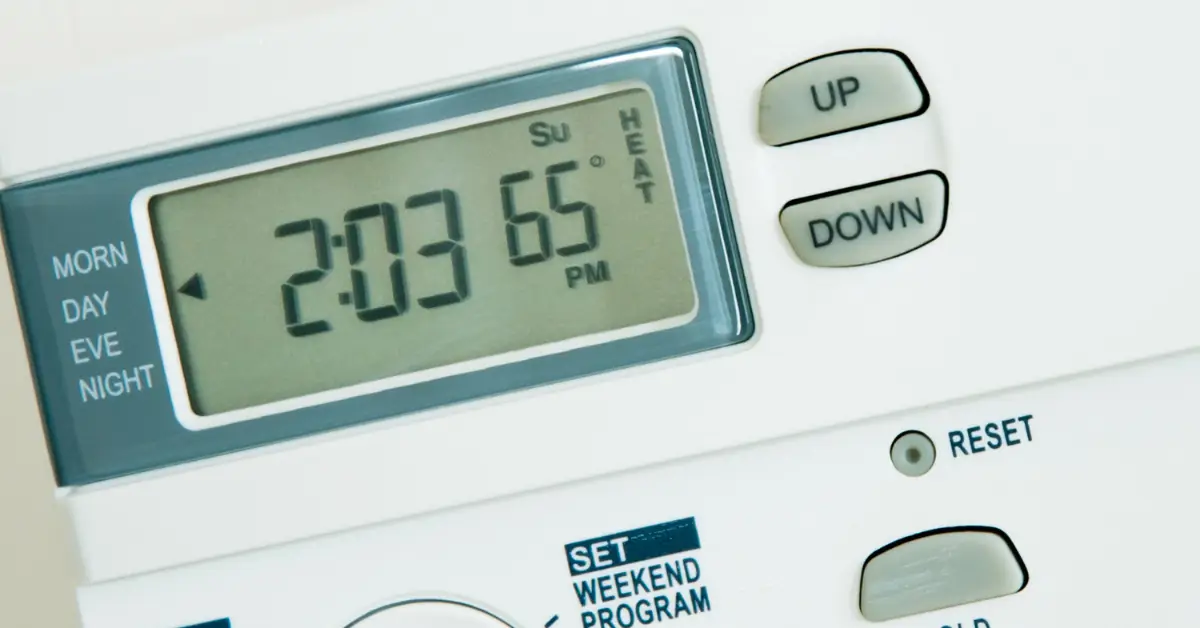
Beyond energy savings, programmable and smart thermostats offer numerous comfort and convenience benefits:
- Precision temperature control – Set different temperatures for different times of the day, tailoring comfort to your routine.
- Vacation and away modes – Put your system on a minimal setting while you’re out of town and remotely bring it back to comfort before you return.
- Maintenance reminders – Many thermostats remind you when it’s time to change filters or schedule HVAC maintenance. Regular filter changes can reduce energy consumption by up to 15%.
- Integrations with smart home platforms – Smart thermostats can work with other devices like smart lights, blinds or security systems. Some can even respond to utility demand response programs or adjust based on local weather forecasts.
- Energy‑use tracking – Apps associated with smart thermostats provide detailed reports about your HVAC run times, helping you identify opportunities for further savings or detect issues like short cycling or mechanical problems.
Installation and Compatibility
Most programmable thermostats require a “C‑wire” (common wire) to supply continuous power, while battery‑powered models exist for simpler systems. Smart thermostats almost always need a C‑wire. Before purchasing, check your existing thermostat wiring or consult a professional.
Compatibility with your HVAC equipment is also crucial. Systems with multi‑stage heating or cooling, heat pumps, humidifiers or whole‑house dehumidifiers may require specific thermostat models. A professional installer can ensure the thermostat is wired correctly and configured for your system, preventing issues like improper fan operation or heating strip activation. Improper installation can reduce efficiency by up to 30%, so expert help is worth the investment.
Cost and ROI
Programmable thermostats range from about $25 for basic models to around $100 for advanced ones. Smart thermostats cost between $150 and $300 or more, depending on features. While the initial cost is higher for smart models, the additional convenience and adaptability can make them more cost‑effective in the long run. Considering ENERGY STAR’s estimated annual savings of around $180 for proper programming or 8% for smart models, most thermostats pay for themselves within a year or two.
Rebates and incentives may further reduce the cost. Some utility companies offer discounts for installing smart thermostats or participating in demand response programs that reduce peak energy consumption. Ask your energy provider or consult a local professional for current offers.
Conclusion
Installing a programmable or smart thermostat is a simple, affordable upgrade that delivers impressive returns. By automatically adjusting temperatures based on your schedule, you minimize wasted energy while maximizing comfort. Combined with regular HVAC maintenance and other energy‑saving measures, a thermostat upgrade can significantly reduce your utility bills and carbon footprint.
If you’re ready to enhance comfort and savings in your Ashland home, contact Extreme Heating & Air Conditioning and Electrical Services. Our experts will help you select a compatible thermostat, handle installation and teach you how to program it for optimal performance. We’ll also ensure your HVAC system is ready to take full advantage of this smart technology. Reach out today to start saving and living more comfortably.